 Talent Summoner
A 30-Minute Hiring Calibration Checklist for Founders
A copyable 30-minute hiring calibration agenda for founders to align the brief, evidence, sample profiles, disagreements, changes and next gate.
 By Kevin Wong · Published · Updated · in Hiring Process
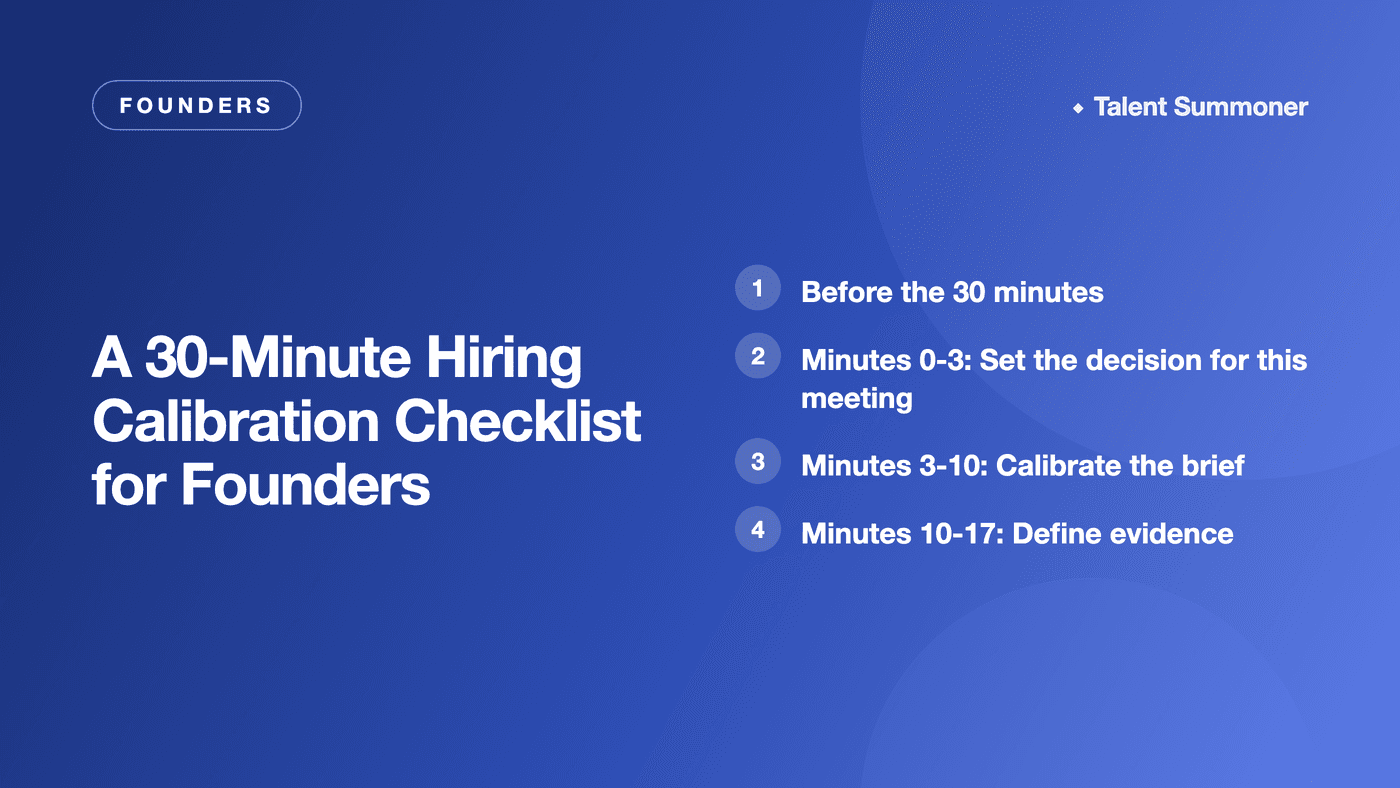
A short calibration makes a hiring brief usable by the founder and reviewers. This agenda aligns the role need, relevant evidence and next action.
The 30 minutes is a chosen timebox for alignment. It is not evidence that the role is ready, a guarantee that the group will reach agreement, or a universal requirement for hiring. If an important question remains open, assign an owner and follow-up rather than forcing a decision to fit the clock.
Before the 30 minutes
Name a facilitator, role owner, final decision-maker and note-taker. Bring the role brief and an illustrative sample of profiles or CVs: promising, borderline, unexpected and adjacent examples. This is a working sample, not a market benchmark.
Open a shared record with the date, attendees, brief version and change log. Keep criteria job-related.
Minutes 0-3: Set the decision for this meeting
State the outputs: an agreed brief, evidence standard, sample review and next gate. Read the role and intended work outcome aloud.
Checklist:
If the outcome is disputed, record an outcome-definition follow-up.
Minutes 3-10: Calibrate the brief
Turn the job description into decisions. Separate must-haves, nice-to-haves and operating constraints. A must-have describes a capability needed for the work, not a familiar employer, title or career path.
Checklist:
Ask, "What would change our view if we found it?" Mark each item as a screening rule, assessment question or later verification.
Minutes 10-17: Define evidence
For every must-have, write inspectable evidence and its limits. A public profile, CV, portfolio or project description may support a hypothesis, but may not establish ownership, availability, performance or every claim. Missing detail is an unknown, not proof of inability.
Checklist:
Remove criteria based on protected traits, stereotypes or status signals. Agree what evidence is enough to progress; do not turn a signal into a hiring verdict.
Minutes 17-23: Review the sample profiles
Review the same illustrative sample against the criteria: evidence first, interpretation second. Include an adjacent background where its work could transfer. Explain which requirement changed each reviewer's view and what remains unknown.
Checklist:
Minutes 23-27: Surface disagreements
Ask each reviewer to name one disagreement. Classify it as a definition, evidence, adjacent-route or operating-boundary issue so a preference does not quietly become a rule.
Checklist:
Minutes 27-30: Log changes and set the next gate
Finish with a versioned record: old wording, new wording, reason, approver and date. Keep the original brief and sample review for comparison.
Checklist:
The next gate is not automatically "the role is ready". If outcome, budget, evidence or authority is unresolved, name the follow-up owner and due date. Record the gate's required output and review date.
Where Talent Summoner fits
Talent Summoner is our product for candidate discovery and ranking, not calibration. Its candidate-sourcing tool, checked 3 October 2026, starts with a role brief and searches LinkedIn, GitHub and other public professional sources across 200M+ profiles. It returns a ranked shortlist; your team verifies claims, contacts candidates and decides.
If CVs are already in hand, the separate candidate-ranking tool organises supplied material. Talent Summoner is not an ATS, does not manage an application pipeline or automatically reject candidates, and sends outreach email only after you review and confirm it. Keep status, messages, interview evidence and decisions in your team's system.
Next step
Copy the checklist into the role record, invite the decision-maker and bring a small labelled sample where available. Assign every open question before you start candidate sourcing.
FAQ
Is 30 minutes enough to calibrate every role?
No. Thirty minutes is a chosen alignment timebox, not a universal requirement or readiness evidence. Assign follow-ups when key issues remain unresolved.
What should a hiring calibration meeting decide?
It should agree the outcome, criteria, evidence questions, boundaries, change approver and next gate. It does not prove capability from a shortlist or sample.
What happens when reviewers still disagree?
Name the criterion and evidence, classify the disagreement, then assign a decision-maker or follow-up owner. Record the question.
Talent Summoner product facts read from our live candidate sourcing, candidate ranking and pricing pages, verified 3 October 2026. We re-verify this page quarterly — tell us if something changed.