 Talent Summoner
How to Source Candidates When Job Titles Mislead
Learn how to source candidates by skills, scope and evidence when job titles vary across companies and industries.
 By Derek Chau · Published · Updated · in Candidate Sourcing
When a job title is misleading, searching for that exact title can hide relevant candidates. A "product manager" may own discovery, delivery or a narrow feature area depending on the organisation. The wording is a useful clue, but it is not a complete description of the work.
Do not discard titles or assume that they are useless. Use a title as one search signal, then describe the skills, scope and evidence the role needs. Explore adjacent backgrounds without treating employer prestige, degree, location, profile polish or years listed as proof of ability.
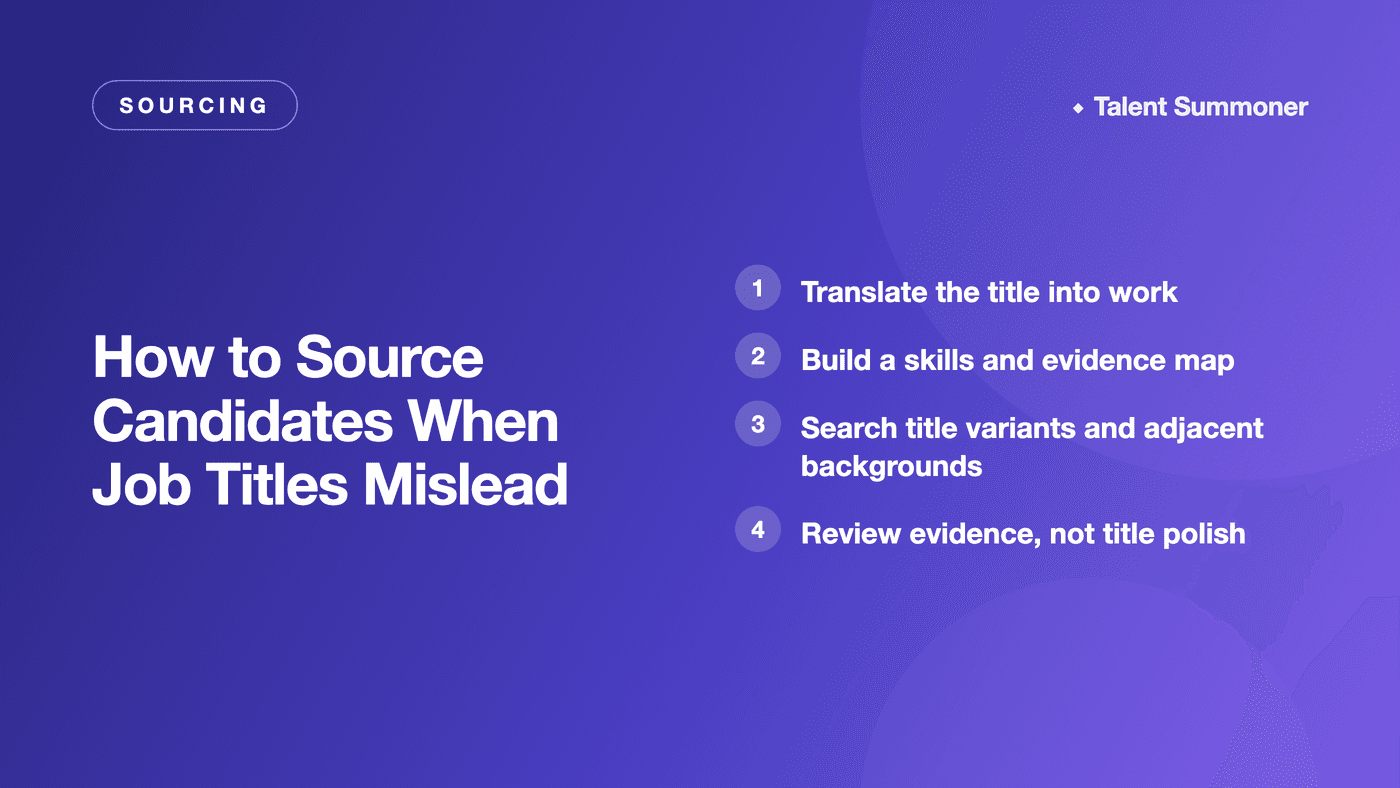
Translate the title into work
Start with the work behind the label. Write the outcome, decisions, constraints and people or systems the person will affect. Then separate genuine must-haves from preferences.
For example, a brief for a "technical account manager" might require diagnosing integration problems, explaining trade-offs to non-technical customers and coordinating a resolution across engineering and support. Those requirements are more useful than an exact-title filter. They also give a reviewer something concrete to verify later.
Keep the language observable: replace "strategic" with a decision or result, and define "senior" through ownership, ambiguity or stakeholder responsibility. If a qualification or location is a real constraint, explain why it is job-related.
Build a skills and evidence map
Turn the brief into a small map with four parts:
- Capabilities: the activities the person must perform, such as designing an API, managing a renewal or investigating a security incident.
- Context: the environment that matters, such as regulated data, a particular customer type, a distributed team or a specific delivery model.
- Scope: the ownership and decisions expected, including whether the person leads a project, a system, a portfolio or a team.
- Evidence: what could support each requirement, such as a public project, a case study, a described launch or a focused interview question.
Do not confuse evidence with certainty. A profile can show that a candidate describes relevant work; it cannot by itself prove the full scope, quality or current status of that work. Mark each requirement as supported, adjacent or unknown, and keep the question that a human still needs to ask.
Search title variants and adjacent backgrounds
Use the skills map to create several routes into the search. Include the common title, older titles, department-specific labels and titles used by adjacent teams. Add the tools, methods, domains and outcomes that make the work recognisable. Search combinations of these signals rather than requiring every phrase to appear together.
For a role involving customer integrations, adjacent searches might include implementation, solutions, technical enablement and developer relations. Each category is a reason to inspect evidence, not proof that every person can do the job.
Review evidence, not title polish
For every promising profile, keep a short evidence record:
- Requirement: the must-have or outcome being assessed.
- Source: the public page, CV or work sample and the date reviewed.
- Visible evidence: what the source actually says or shows.
- Uncertainty: what is missing, ambiguous or potentially outdated.
- Question: what the candidate or hiring team must confirm.
An exact title can support a follow-up question about responsibility, but it is not proof of seniority or performance. A different title should not be treated as a negative when the underlying work appears relevant. Likewise, a missing keyword is not proof that a skill is absent. Public professional information is selective, and a candidate may have done work that they chose not to publish.
Keep discovery separate from verification. A sourcing result identifies who deserves a closer look; it does not establish interest, availability, capability or fit. Let the candidate confirm whether the role is relevant.
Use feedback to improve the next search
Start with a brief that includes the title as an optional clue. Review direct and adjacent matches for false positives, missing backgrounds and requirements no profile can evidence. Change one term, weighting or boundary at a time, and record whether each result is direct, adjacent or unresolved. Human reviewers decide what to verify, whom to contact and what happens in an interview.
Talent Summoner is our product for this discovery step. Its candidate-sourcing workflow, checked on 3 October 2026, starts with a role brief and searches LinkedIn, GitHub and other public professional sources across 200M+ profiles. It returns a ranked shortlist with must-haves, nice-to-haves and plain-English reasoning; feedback can adjust a later search and its weighting.
If you already have CVs, the separate candidate-ranking tool accepts up to 50 files in PDF, DOCX, MD or TXT format, requires no account and creates a shareable report. Talent Summoner is not an ATS and does not automatically reject candidates. Sourcing is free to start; see current pricing, checked on the same date, for Role packs and the monthly option.
Bottom line
Titles vary, but the work still needs a clear definition. Translate the role into capabilities, context, scope and evidence; search adjacent language; and verify claims without turning proxies or missing data into conclusions.
FAQ
Should I ignore job titles when sourcing?
No. Titles are useful discovery signals, but their meaning varies by organisation. Combine title variants with skills, scope, context and evidence instead of making an exact title a hard requirement.
How do I assess a candidate with a different title?
Compare the work described with the role's must-haves. Record the source, visible evidence and uncertainty, then ask a focused question about ownership or outcomes. Do not infer ability from employer, education, location or other proxies.
Can Talent Summoner search beyond exact job titles?
Its sourcing workflow starts with a role brief and searches public professional sources against the criteria. Include the capabilities, context and adjacent terms you want reviewed, then inspect the ranked reasoning and verify candidates yourself.
Next step
Choose one open role, rewrite its title as three observable capabilities and add one evidence question for each. Then start a focused candidate-sourcing search and review both direct and adjacent matches against the same brief.
Related: Passive Candidate Sourcing Without Mass Outreach: A Practical Guide · How to Source Candidates from One Job Description · How to Search for Adjacent Backgrounds in Recruiting
Talent Summoner product facts read from our live candidate sourcing, candidate ranking and pricing pages, verified 3 October 2026. We re-verify this page quarterly — tell us if something changed.