 Talent Summoner
Why Keyword Matching Misses Strong Candidates
See why recruitment keyword matching misses relevant evidence, where it still helps, and how to combine it with controlled human review.
 By Nicholas Yan · Published · Updated · in Candidate Sourcing
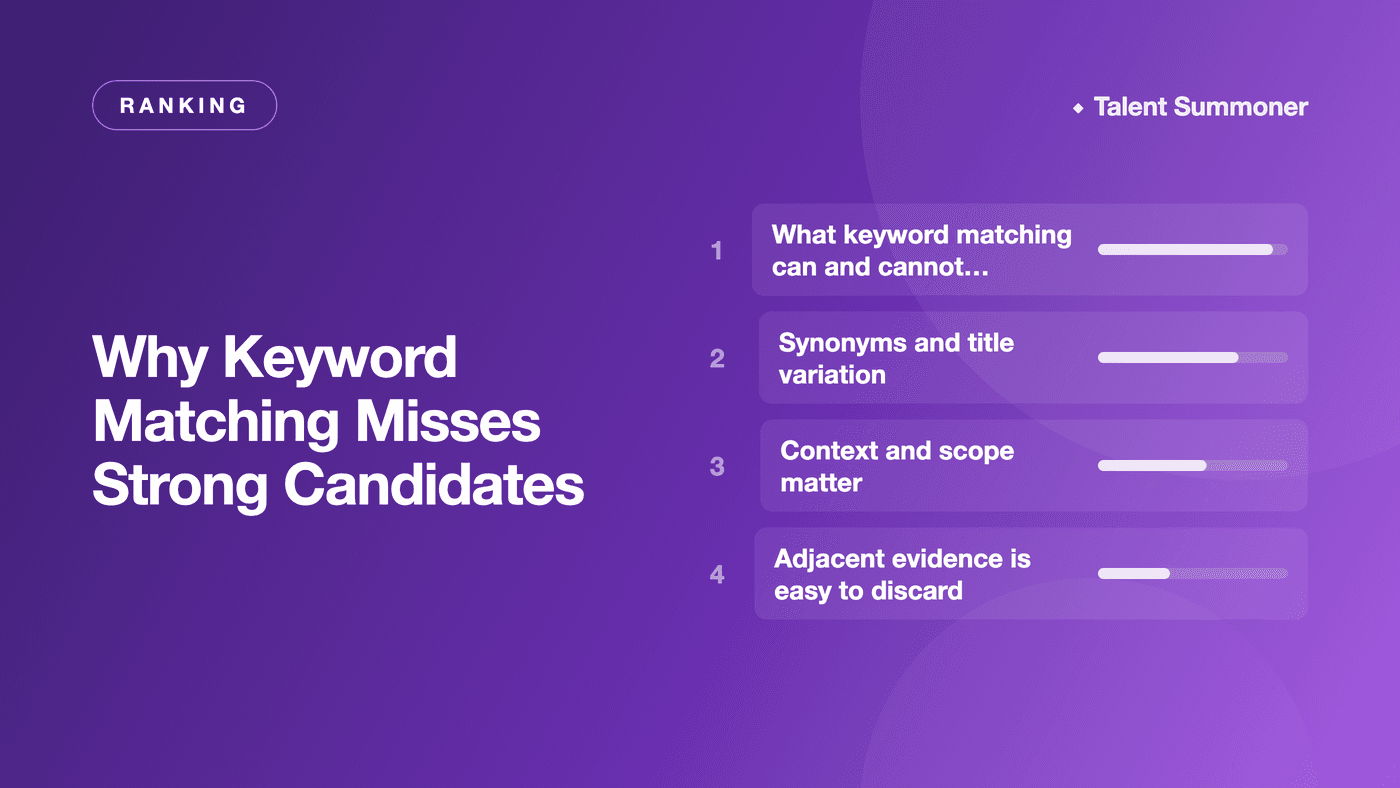
Keyword matching in recruitment looks for the same words in a job description and a CV or public profile. It is fast and easy to explain, but the result depends heavily on wording. A potentially relevant profile can be missed because it uses a synonym, a different title or evidence that does not repeat the requirement verbatim.
That does not make keywords useless. They remain useful for hard constraints, initial search terms and quick checks. The risk is mistaking a phrase match for evidence of capability, or a missing phrase for evidence that someone cannot do the work.
What keyword matching can and cannot see
An exact match can identify an explicit term such as "Kubernetes" or "Cantonese", and provides a reproducible first filter when the term has a stable meaning and is genuinely required. It usually says little about ownership, depth, recency, scale or setting.
A profile may list "Python" without production context, while another describes data pipelines but omits "ETL". An exact filter separates them before surrounding evidence is read.
Synonyms and title variation
People and employers describe similar work differently. "Site reliability engineer", "platform engineer" and "production infrastructure engineer" may overlap without being interchangeable. "Customer success" may include work another employer calls "account management". A CV may use a product name, internal title or category label instead of the job description's wording.
Build a small synonym set, record what each term might indicate, and read the surrounding evidence. Broader coverage can improve recall while adding topical noise.
Context and scope matter
The same word can describe different work: "led" might mean managed a team, owned a workstream or coordinated a meeting. "Security" and "scaled" also vary by scope. Keyword matching cannot reliably distinguish those meanings.
Define the relevant scope in the brief: work type, ownership, environment, users or systems affected, and approximate complexity. Then ask whether the surrounding evidence supports it. A related use of the required tool may merit review, but should lead to a verification question, not a confident conclusion.
Adjacent evidence is easy to discard
Relevant experience is not always a literal copy. An analyst who automated operational reporting may have adjacent evidence for data engineering. That is a hypothesis, not proof.
Label a signal direct, adjacent or unknown, then write the missing bridge: what transfers, what context differs and how the team will verify it. A narrow keyword rule can hide this route; an unbounded similarity system can overstate it. A declared adjacent path gives a person something inspectable.
Keyword stuffing and noise
More occurrences do not mean more relevant experience. A repeated phrase may be copied or merely name a tool in the environment; a concise CV may give better evidence.
Check section and relationship: is the term attached to a project, responsibility, outcome or date? Is it a must-have, preference or noise? Deduplicate mentions and do not count a copied requirement as independent evidence. A keyword can open review; it should not close it.
Semantic or AI matching is not automatically better
Semantic and AI matching can recognise related language, but similarity can still be wrong. A model may miss scope or infer a capability the source does not establish. Tools also expose different criteria and controls.
Compare methods on the same brief and candidate set. Ask which profiles each surfaces, what evidence it shows, how it handles unknowns and whether a reviewer can challenge the reasoning. Treat every method as a prioritisation aid, not a performance prediction or automatic decision.
A controlled hybrid review
Use a repeatable sequence:
- Write must-haves, nice-to-haves and genuine constraints in plain language.
- Add limited synonyms and one or two acceptable adjacent backgrounds for difficult requirements.
- Use exact terms for stable constraints, then inspect the context around each hit.
- Sample matches, non-matches and surprising omissions. Label each criterion direct, adjacent, contradicted or unknown.
- Record one verification question for every material unknown. Keep criteria visible when changing a weighting or term.
- Re-run after one controlled change and compare what entered, left or moved. A human decides whether to progress, verify, hold or close.
This preserves keyword speed while making errors traceable to terms, scope, noise or missing evidence.
Where Talent Summoner fits
Talent Summoner is our product for AI candidate sourcing, CV ranking and outreach you confirm before it sends. Its live Candidate Ranking tool, checked 3 October 2026, accepts up to 50 CVs in PDF, DOCX, MD or TXT format, requires no account and creates a shareable report with plain-English reasoning. Use it to organise review, then inspect the material and decide what to verify; it is not an automatic hiring decision.
For people beyond an existing CV pool, see candidate sourcing. Review current pricing after defining your cadence and retained review work. Use live pages for current terms.
Bottom line
Keywords are useful signals, not a complete definition of relevance. Combine controlled terms with context, scope, adjacent evidence and human verification.
FAQ
Are keywords useless in recruitment?
No. They work well for stable constraints and initial discovery. The error is treating a phrase as proof of depth or ownership.
Why can synonyms cause missed candidates?
Equivalent work may use another title, product name or employer-specific term. A limited synonym set can miss it before review.
Is semantic matching always better than keyword matching?
No. It may recognise related language but confuse topical similarity with relevant scope. Compare methods against the same evidence and controls.
What should I do with an adjacent match?
State what may transfer, what differs and what question will verify it. Label the signal adjacent rather than accepting or rejecting it automatically.
Choose one open role, define three job-related must-haves and run a controlled review in the Candidate Ranking tool. Ask the role owner to label each result before acting.
Related: What a Transparent Candidate Ranking Report Includes · Resume Ranking vs Candidate Matching: What Is the Difference? · Must-Have vs Nice-to-Have Requirements in Candidate Matching
Talent Summoner product facts read from our live candidate sourcing, candidate ranking and pricing pages, verified 3 October 2026. We re-verify this page quarterly — tell us if something changed.