Talent Summoner
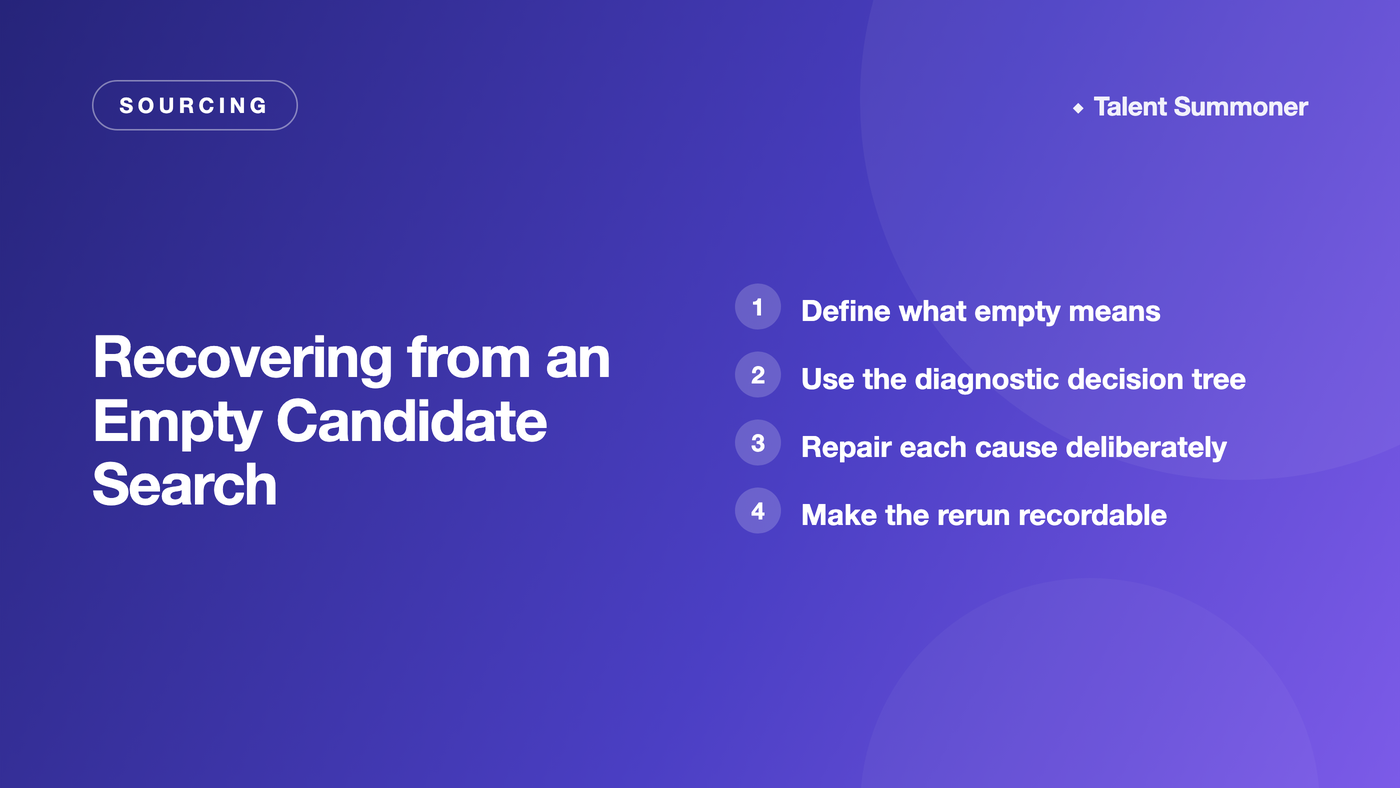
Recovering from an Empty Candidate Search
Diagnose an empty candidate search before rerunning it: separate brief defects, market constraints, evidence gaps and scope changes.
Your hiring manager search returns no profiles worth reviewing. The instinct is to add more keywords, remove a constraint or search again immediately. That can make the next result impossible to interpret.
An empty candidate search is a diagnostic signal, not a conclusion about the talent market. First decide whether the problem is in the brief, the approved market constraints, the evidence available in public sources or the search scope that was actually tested. Then make one documented decision about what happens next.
Define what empty means
Separate three outcomes:
- No results: the search returned no records under the terms and boundaries used.
- No usable results: records appeared, but none exposed enough job-related context to review.
- No verified match: plausible records appeared, but a material claim remains unanswered.
Do not collapse these into "there are no candidates". LinkedIn explains that a public profile is simplified and that people control which sections are visible. Missing text can therefore be an evidence gap, not proof that a person lacks the skill. Preserve the query, source, date, constraints and unanswered questions.
Use the diagnostic decision tree
Start at the top and stop at the first answer that explains the empty result. The labels are process diagnoses, not judgements about people.
| Question about the failed search | Diagnose as | Action before rerunning | Stop condition |
|---|---|---|---|
| Can the role owner state one outcome, genuine must-haves and the evidence needed for each? | Brief defect | Rewrite the outcome and separate must-haves from preferences. Remove proxy requirements such as an impressive title when they are not job-related. | Pause until the owner approves a brief that another reviewer can apply consistently. |
| Does an approved location, working pattern, start requirement or eligibility boundary rule out the route the team expected to use? | Market constraint | Ask the owner to confirm the constraint and record which alternative, if any, is authorised. Do not silently relax it. | Stop when no authorised boundary change exists; record the constraint rather than claiming the market is empty. |
| Do plausible profiles exist, but the public record cannot show ownership, scope, recency or another material criterion? | Evidence gap | Write one verification question and mark the criterion unknown. Use a human conversation or an approved source to answer it. | Stop when the next step would require inferring a private, sensitive or irrelevant fact from silence. |
| Was only one title, phrase, source or interpretation of the approved scope tested? | Search-scope change | Name the single scope variable to change, the reason for it and the evidence it should reveal. Keep the rest of the brief fixed. | Stop when no owner-approved variable or expected signal is written down. |
If more than one diagnosis seems plausible, record the primary cause and the competing explanation. Do not change a brief and a location at the same time: the result would not tell you which decision mattered.
Repair each cause deliberately
Brief defect
A brief defect is an internal clarity problem: incompatible must-haves, a seniority label standing in for scope, or a preference treated as a rejection rule. Return to the work outcome. For each requirement, write what a source could show and what needs a human check.
The hiring manager owns the correction. A recruiter can propose wording, but should not lower a genuine requirement to create results. If the owner cannot explain why a criterion matters, pause rather than searching harder.
Market constraint
A market constraint is a real operating boundary, such as a required working window or eligibility rule. It is not proof that a location contains no suitable people. Record the boundary, approver and any authorised alternative. Route employment status, work authorisation, tax and local-law questions to HR, legal or a qualified local adviser; this is general information, not legal advice.
Evidence gap
An evidence gap means a possible route surfaced but the source cannot answer a material question. Separate unknown from not present. Ask for the smallest job-related fact that would resolve it, such as project contribution or responsibility scope. Do not fill the gap with employer prestige, a keyword, a photo or guessed availability.
The UK's Information Commissioner's Office highlights data minimisation, transparency, fairness and accuracy questions for AI-assisted recruitment. Keep role-relevant records, retain the source and review date, and assign a human verification owner. Its guidance is general information, not a conclusion about your legal duties.
Search-scope change
A scope change deliberately alters how the approved question is searched: a role synonym, adjacent background or approved source. Write the before-and-after wording and expected signal. A broader query helps only if the hiring manager agrees how an adjacent result will be reviewed.
Compare evidence quality and coverage, not just record count. If the same pattern returns, revisit the diagnosis, escalate the unresolved decision or close with a reason.
Make the rerun recordable
Before rerunning, capture this short note in the role record:
Failed search and date:
Observed outcome: no results / no usable results / no verified match
Primary diagnosis:
Evidence supporting the diagnosis:
Approved change, if any:
Expected signal from the rerun:
Owner and review date:
Stop condition:
Decision after rerun: continue / verify / revise / pause / close
This record keeps a thin pipeline from becoming unbounded work. A stop decision can be correct even when the reason is unresolved: it tells the next owner what must change. NIST describes its AI Risk Management Framework as voluntary. Its risk-management framing supports visible assumptions, evidence and ownership; it is not a hiring standard or accuracy guarantee.
Where Talent Summoner fits
Talent Summoner is our product for role-based discovery and ranking. Its candidate-sourcing workflow, checked on 2 September 2026, starts from a role description, searches LinkedIn, GitHub and other public sources across 200M+ profiles, and returns ranked results against must-haves and nice-to-haves with plain-English reasoning. Use it to test an approved hypothesis, not to measure a local market or prove interest, availability or suitability.
When the input is an existing CV set, candidate ranking is the separate workflow. It organises supplied CVs against a job description, but does not repair an unclear brief, verify public claims, manage an application pipeline or make the hiring decision. Your hiring manager owns scope, verification, contact, interviews and selection.
FAQ
What should I do first when a candidate search is empty?
Classify the result as no results, no usable results or no verified match. Use the tree to identify the cause before rerunning.
Does an empty search prove there are no suitable candidates?
No. It describes only the terms, sources and boundaries tested. Public profiles can be selective, leaving a signal unknown.
Should I remove requirements to get more results?
Only the role owner can approve changing a genuine requirement. First check for a brief defect or accidental preference, then record the expected evidence.
How many times should I rerun an empty search?
There is no universal number. Rerun when an approved change has a reason and expected signal. Stop when the diagnosis persists, no authorised change exists or the next step requires guessing.
Can Talent Summoner fix an empty candidate search automatically?
No. Our product provides discovery and ranking; your team diagnoses the cause, approves scope, verifies evidence and decides whether to continue.
Write the diagnosis and stop condition beside the failed search, obtain approval for any scope change, and then run a focused candidate-sourcing search. For an existing CV set, use candidate ranking and keep it separate from the discovery diagnosis.